/Logo_ISO-Gruppe_RGB_negativ_alles.png?width=125&height=75&name=Logo_ISO-Gruppe_RGB_negativ_alles.png)
Atlassian Isolated Cloud is a dedicated cloud deployment option for enterprises with high requirements for security, data control, and compliance. It complements the existing multi-tenant cloud architecture by providing a more isolated environment with separate resources for each customer.
To date, Atlassian has enhanced its cloud offering with a number of measures:
- Choice of data storage location (“Data Residency”)
- Customer-managed keys for data encryption
- Support for regulatory frameworks (IRAP Information Security Registered Assessors Program – Australia, BSI C5 Type II)
- A dedicated cloud offering for U.S. government customers and their partners
Atlassian has now taken the next step with the “Atlassian Isolated Cloud.” The solution is available on the market immediately. It was designed as a specialized deployment option for customers who face regulatory or internal risk management challenges with multi-tenant cloud solutions.
Who is the Isolated Cloud suitable for?
The Atlassian Isolated Cloud is particularly beneficial for teams and organizations that work with sensitive information and require a clearly demarcated cloud environment for this purpose. This includes, for example, companies in highly regulated industries such as financial services, healthcare, or critical infrastructure.
The model is particularly relevant for organizations that:
- need a dedicated cloud environment for each customer,
- want to exercise greater control over data outflow,
- have higher requirements for infrastructure isolation,
- need to better align their security and compliance requirements with the cloud.
How does the Isolated Cloud differ from a multi-tenant architecture?
The existing Commercial Cloud is based on a multi-tenant architecture. This means that multiple customers share certain platform and infrastructure components.
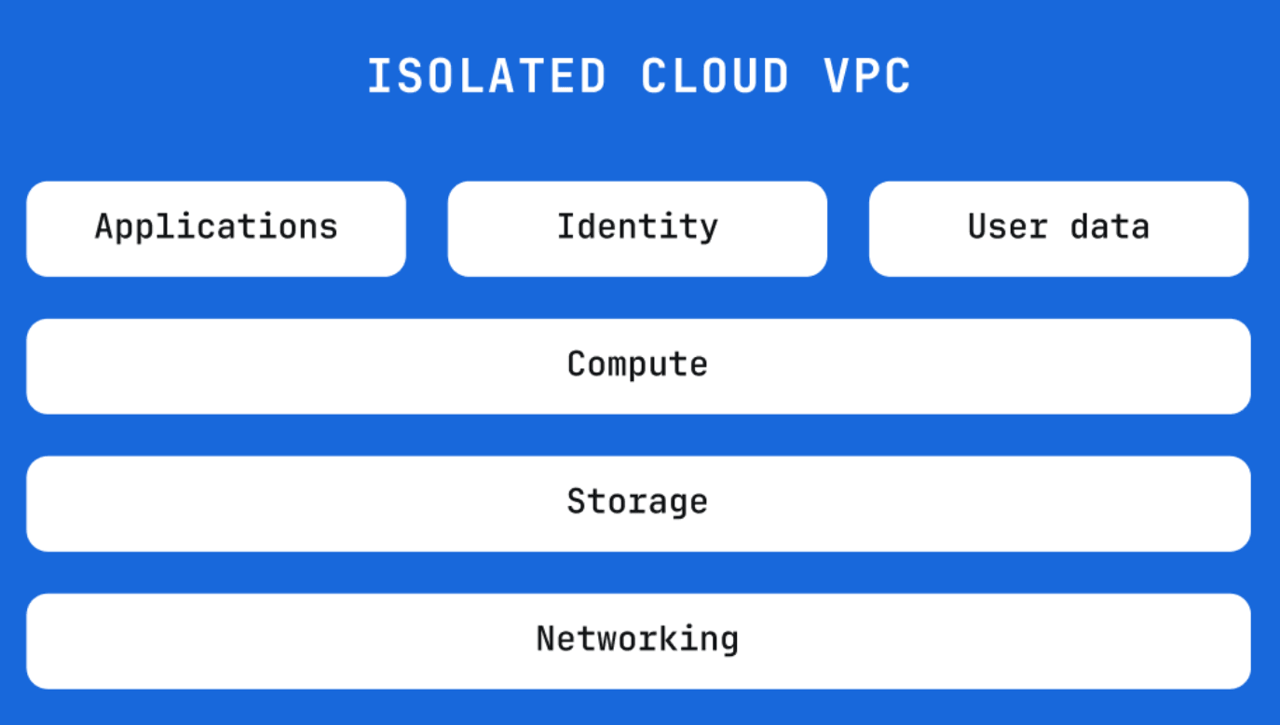
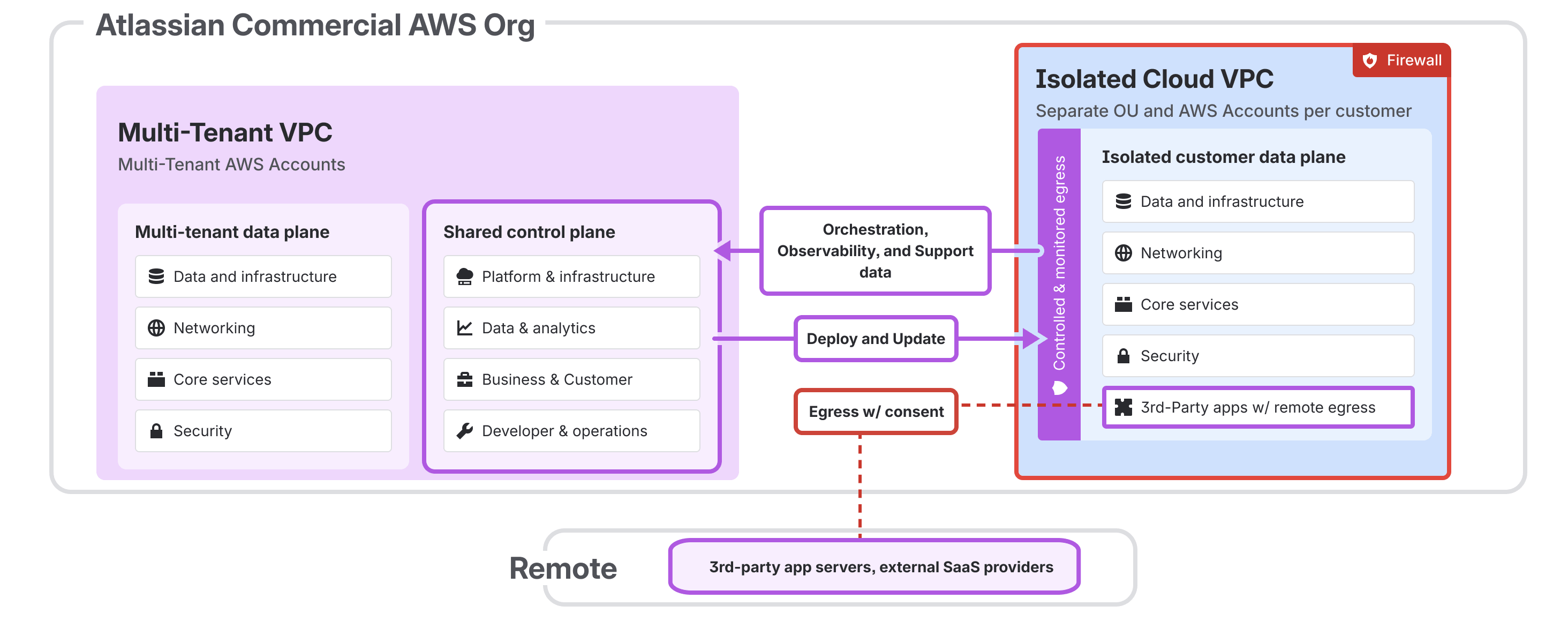
The Atlassian Isolated Cloud differs from the multi-tenant commercial cloud in that it provides a fully dedicated environment for each customer, which includes separate AWS accounts, an isolated data layer, and its own VPC (Virtual Private Cloud). Unlike the shared infrastructure in the Commercial Cloud, the Isolated Cloud offers a dedicated network for stricter separation of customer data.
Comparison of the Two Models
|
Aspect |
Commercial Cloud (Multi-Tenant VPC) |
Atlassian Isolated Cloud VPC |
|
Deployment model |
Shared cloud environment for multiple customers |
Dedicated cloud environment per customer |
|
AWS Architecture |
Multi-tenant AWS accounts |
Separate organizational unit and separate AWS accounts per customer |
|
Data layer |
Shared data and infrastructure resources |
Isolated customer data plane with dedicated resources |
|
Network |
Shared network environment |
Dedicated network with clear separation |
|
Security |
Centralized security and platform functions |
Additional isolation, firewall, and controlled access |
|
Operations |
Joint management and platform operation |
Separate operations and support processes with controlled data transfer |
|
External Data Traffic |
Egress possible with customer consent |
Controlled and monitored egress by default |
|
Suitable for |
Companies with standard cloud and scaling requirements |
Companies with high security, compliance, and isolation requirements |
What features are included?
At launch, Atlassian Isolated Cloud supports core Atlassian products such as Jira, Confluence, and Jira Service Management, as well as Guard Standard and other platform apps like Home, Teams, Goals, Projects, and Assets.
In addition, paid security add-ons such as Atlassian Guard Premium and customer-managed encryption keys are supported. This allows the environment to be more closely tailored to internal corporate security requirements.
What does this mean for data flows?
A key feature of Isolated Cloud is controlled data outflow. Outbound traffic is blocked or severely restricted by default, allowing organizations to decide for themselves when data is permitted to leave the environment.
This reduces the risk of data loss and provides greater transparency into what information is being transferred and where. Especially in regulated environments, this level of control is often a decisive factor in cloud strategy.
What does this mean for app development?
Important for developers: Atlassian Isolated Cloud supports Forge apps, while Connect and Connect-on-Forge modules are not supported.
What is the difference between Connect and Connect-on-Forge modules?
Connect modules are the older, or deprecated, modules of Marketplace apps that define how these apps connect to native Atlassian apps like Jira and Confluence and where the extended functionality is integrated.
Connect-on-Forge modules are used by apps that are already registered on the Forge platform but still rely on the deprecated Connect modules; in other words, they serve as a bridge during the transition to Forge apps.
This means that app architectures should be tailored to the target environment early on. Anyone wishing to develop products or integrations for Isolated Cloud customers should verify the requirements regarding hosting type, egress behavior, security model, and pricing logic.
When configuring the app, select “Isolated Cloud” as the hosting type. Advanced editions and pricing for multiple instances are not yet supported and must be taken into account during product planning.
Isolated Cloud in Atlassian’s Cloud Portfolio
With Atlassian Isolated Cloud, Atlassian is expanding its cloud portfolio to include another deployment option between the traditional Commercial Cloud and highly regulated service models.
This development clearly shows that Atlassian is gradually expanding its cloud options so that even customers with stricter security and compliance requirements can consider adopting modern cloud solutions. For businesses, this means greater freedom of choice while maintaining a high level of platform standardization.
Our Conclusion
Atlassian Isolated Cloud is a logical next step for organizations with heightened security and control requirements. The solution combines the advantages of a modern SaaS platform with significantly stronger isolation at the infrastructure and data levels.
For organizations with sensitive data, strict compliance requirements, or high governance standards, the Isolated Cloud can thus be a key building block for cloud migration. At the same time, it creates a new target model for partners, consultants, and app providers that must precisely align technical and commercial requirements.
Guidance for Businesses
Anyone considering a move to the Atlassian Cloud today should include the Isolated Cloud in their evaluation early on. The key question is not just whether the cloud is feasible, but which type of cloud best supports your organization’s security and operational requirements.
Benefits for Your Business:
- Your data, computing power, storage resources, and network connections are located in a physically isolated cloud environment set up specifically for your company. This ensures true isolation.
- Outbound data traffic is blocked by default. This allows you to decide for yourself when data is permitted to leave your environment.
- You also significantly reduce the risk of data leaks or data exposure caused by shared infrastructure.
For regulated industries in particular, this new option may have been the missing piece needed to make a strategically sound transition from Data Center or on-premises to the cloud.
If you’d like to explore whether Atlassian Isolated Cloud is right for your organization, we’d be happy to discuss it with you.